 Days Left
“32 days until the exam” is a useful number, but it’s a slightly dishonest one. You don’t have 32 days to revise. You have 32 days minus everything else going on in your life.
Working out the real number, and then planning backwards from the exam, is the easiest way I know to go from vague dread to a plan you can actually follow.
Step 1: count your real study days
Start with the days until the exam. Then take off:
- One rest day a week. Not optional. Tired revision is mostly rereading the same paragraph.
- Days already taken: work shifts, family stuff, a birthday, travel, other deadlines.
- The day before the exam. That’s for a light look over your notes and an early night, not for learning.
Here’s an example. Say the exam is 45 days away. Take off 6 rest days, 4 days that are already booked and the day before, and you’ve got 34 real study days. If you’re sitting five papers, that’s about a week each.
That number is often a bit of a shock. Good. It’s much better to be shocked now than three days out.
Step 2: split the time into phases
Rather than “revise Biology” every day until the exam, think in three phases. Rough proportions:
First 40%: fill the gaps
Go through the syllabus and mark each topic red, amber or green. Spend this phase on the reds and ambers. Make your notes or flashcards here, but keep them short. The goal is to know what you don’t know.
Next 40%: test yourself
This is where most of the learning happens. Flashcards, practice questions, explaining a topic out loud without your notes. Each time you get something wrong, that’s the thing to look at again tomorrow.
Last 20%: past papers, timed
Do full papers under real conditions. Same time limit, no notes, phone in another room. Then mark them honestly. You’ll learn things about timing and question wording that you can’t learn any other way.
Why testing beats rereading
This isn’t just my opinion. In 2013, John Dunlosky and colleagues reviewed hundreds of studies on ten common study techniques. Two came out as clearly the most useful:
- Practice testing: anything that makes you pull the answer out of your head. Flashcards, past papers, quizzing a friend.
- Distributed practice: spreading study for a topic out over days and weeks, instead of doing it all in one go.
Highlighting and rereading, the two things most of us actually do, were rated as low usefulness. They feel productive because the material starts to look familiar. But recognizing something and being able to recall it in an exam hall are different skills.
Planning backwards from the exam helps with both. When you can see the whole stretch, it’s easy to come back to each topic three or four times instead of once.
Step 3: make the countdown visible (but not scary)
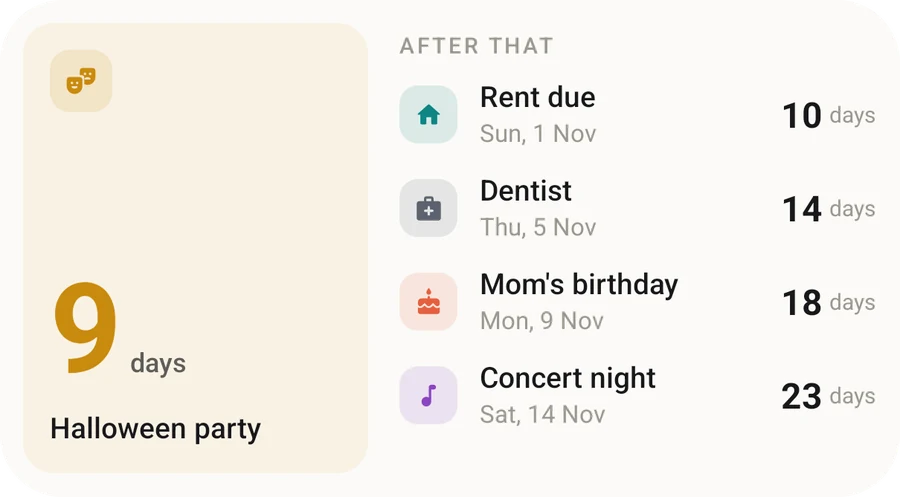
Put each exam in a countdown app, one event per paper, with a tag for the subject. In Days Left, the Up next widget shows the next few on your Home Screen, so you can see at a glance that Chemistry is in 12 days and Math in 19.
A few people find a countdown stressful rather than motivating. If that’s you, try the progress bar instead of the number. Seeing “60% of the way there” tends to feel like progress, where “14 days” can feel like a threat. Days Left shows both on each event, so you can look at whichever helps.
Reminders help too. A reminder a week before each exam is a good point to switch from learning to past papers.
Step 4: leave room for things to go wrong
They will. You’ll get ill, a topic will take three days instead of one, a friend will have a crisis. Build in a buffer: if you’ve got 34 study days, plan for 30. If nothing goes wrong, you get four days of extra practice papers, which is the best possible problem to have.
The day before
Look over your summary notes once. Pack your bag: pens, calculator, ID, water. Check where the exam is and how long it takes to get there. Then stop and sleep. There’s good evidence that sleep helps you hold on to what you’ve learned, and one more evening of cramming won’t make up for a bad night.
Working out the days? If your exam timetable has dates rather than countdowns, here’s how to count the days between two dates, with a calculator.
The review: Dunlosky, J., Rawson, K. A., Marsh, E. J., Nathan, M. J. & Willingham, D. T. (2013). Improving students’ learning with effective learning techniques. Psychological Science in the Public Interest, 14(1), 4–58.
Quick answers
How many weeks before an exam should I start revising?
It depends on the exam and how much material there is, but spreading revision over several weeks works better than cramming. Count your real study days first, then decide whether you need to start earlier.
What is the most effective way to revise?
A large 2013 review of study techniques rated practice testing (testing yourself, past papers, flashcards) and spacing your study out over time as the most useful methods. Rereading and highlighting were rated much lower.
Should I revise the day before an exam?
A light review of key points is fine, but the day before isn't the time to learn anything new. Sleep matters more than one more evening of cramming.